
A Jetocracy Rises
How four billionaire families and two charter operators fuelled India's post-COVID jet boom
India’s commercial aviation sector hit a nadir in 2025: enduring airspace closures and surging costs after the Pahalgam terrorist attack; the catastrophic Air India crash that killed hundreds; and the weeks-long logistical disaster after IndiGo, the country’s largest carrier, failed to comply with new pilot rest norms.
But for the country’s billionaires and C-suite executives, 2025 marked the best year in over a decade, with a record number of business jets added to the official registry. Indeed, since the COVID-19 pandemic in 2020, net additions of business jets in India—after accounting for both registrations and de-registrations—have skyrocketed to unprecedented levels.
On the surface, the trend may seem in line with India’s broader macroeconomic growth. However, a closer look at the data reveals a striking concentration of jet accumulation in the world’s most populous country.
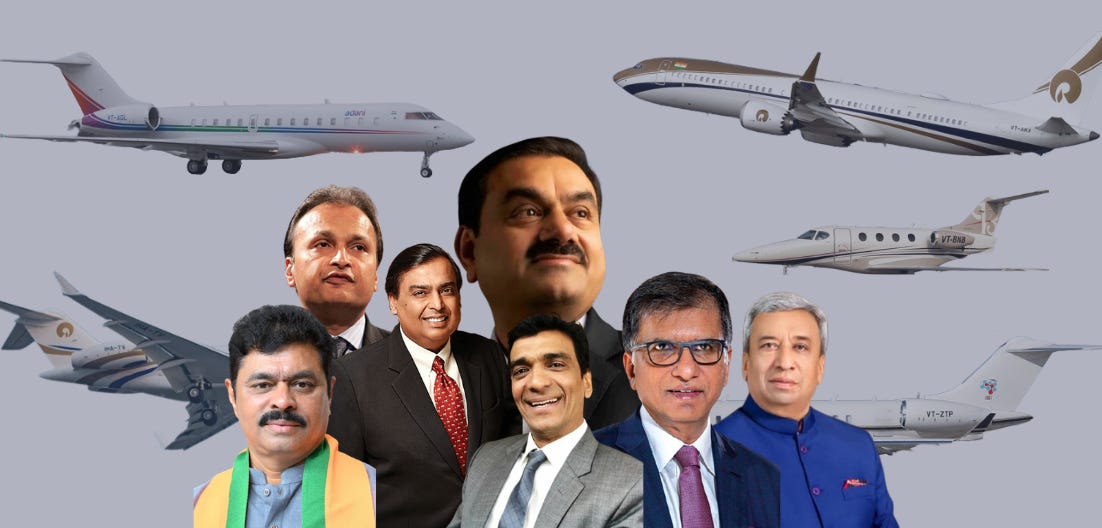
Over half of the net jet additions between 2020 and 2025 are linked to just four billionaire families with a Gujarat connection and two charter operators. These include two of India’s richest families, the Adanis and the Ambanis; Ahmedabad-based pharmaceutical competitors, the Patels and the Mehtas; and charter service providers VSR Ventures and Indo Pacific Aviation.
In this analysis, I focus exclusively on jets registered in India with the Directorate General of Civil Aviation (DGCA)—the apex aviation regulator—for both private and commercial non-scheduled use. Importantly, I have excluded turboprops and helicopters, which are cheaper, have less range, and typically fly at lower altitudes. In other words, nothing screams wealth and power like business jets.
Between 2010 and 2025, a total of 197 business jets were registered and 90 were de-registered, resulting in a net addition of 107 jets, according to an analysis of DGCA data. The year-wise distribution of these jets is illustrated in Chart 1 above. As is evident, there has been a jump in net additions since 2020, after a lull in the preceding few years.
Organising the dataset along three distinct time periods is more illuminating (see Chart 2 below). Between 2010 and 2013, the final years of the Congress-led UPA government—a period marked by high growth rates and corporate exuberance—India recorded a net addition of 34 jets.
Then, after the Narendra Modi-led BJP came to power in 2014, up until the COVID-19 pandemic in 2020, net additions were significantly muted, at just 12 jets. This phase witnessed a severe bad loan crisis, numerous corporate insolvencies, the demonetisation of high-value currency, and the chaotic introduction of the Goods and Services Tax (GST) regime.
Finally, in the post-COVID period of 2020-25, net additions recorded a massive surge. Analysts have identified a K-shaped recovery of the Indian economy during these years, one that has widened income and consumption inequality. Top government officials have also flagged how real wages as recently as 2023-24 stayed below pre-pandemic levels, even as corporate profits soared to multi-year highs.
The four billionaire families and two charter operators named earlier account for a whopping 56% of the net jet additions in the post-COVID period (see Chart 3 below).
The Ahmedabad-based Adani Group leads with seven jet registrations and zero de-registrations. Gautam Adani is 17th on the Bloomberg Billionaires Index (BBI) as of May 31, with a net worth of $119 billion. A key player in multiple sectors, from ports and energy to cement and coal, Adani has seen his fortunes grow manifold over the last decade.
Entities linked to Mukesh Ambani’s Reliance Industries Ltd registered seven jets and de-registered one. The petrochemicals tycoon, who owes his business empire to a large and thriving oil refinery in Gujarat’s Jamnagar, trails Adani on the BBI as the second-richest Indian, ranked 21st with a net worth of $87.6 billion. His embattled younger brother, Anil Ambani, also added a jet to his fleet. While the two brothers split their inherited empire back in 2005, their apparent affinity for private aviation continues to unite them.
The Gujarat connection to India’s post-COVID jet boom continues, with an entity jointly controlled by the Ahmedabad-based pharmaceutical giants Torrent Group and Zydus Group registering five jets and de-registering one. Brothers Sudhir and Samir Mehta of the Torrent Group are ranked 458th and 459th on the BBI, with a net worth of $8.26 billion each. Zydus Group’s Pankaj Patel is ranked slightly above at 415th, worth $9.31 billion.
All jets added by these billionaires are operated by entities included in the DGCA’s list of non-scheduled operators, which allows them to more efficiently manage taxes and charter to group companies.
New Delhi-based VSR Ventures Pvt Ltd, one of the two charter operators, registered nine jets in the post-COVID period and de-registered none. All of these jets were manufactured in 2010 or before, with an average seating capacity of 10 passengers, according to DGCA data. You may remember this operator as the one behind the Learjet 45 business jet carrying then-Maharashtra Deputy Chief Minister Ajit Pawar that crashed in January this year, killing all five on board.
The growth in VSR Ventures’ revenue from operations speaks for itself—jumping from just Rs 64 crore in 2019-20 to a staggering Rs 420 crore in 2024-25, as disclosed in its annual filings with the Ministry of Corporate Affairs (MCA).
VSR Ventures also operates a jet owned by a firm linked to APL Apollo Tubes Ltd—a manufacturer of downstream steel products promoted by New Delhi-based Sanjay Gupta—which was registered in 2024. This jet is not included in VSR Ventures’ tally in Chart 3 above.
Indo Pacific Aviation Pvt Ltd, also based in New Delhi, registered seven jets and de-registered none. Six of these are included in the latest list of jets approved for non-scheduled commercial use, all manufactured between 2005 and 2009, with an average capacity of nine passengers. Three appeared to be leased, whereas the remaining were owned by the operator itself at the time of registration.
In addition to the above, three more entities added two jets each in 2020-25. These include a company linked to BJP Rajya Sabha MP Chintakunta Munuswamy Ramesh-promoted Rithwik Projects Pvt Ltd; a firm linked to Ahmedabad-based real estate developer B Safal Group, promoted by brothers Rajesh and Rupesh Brahmbhatt; and Saffron Strokes Pvt Ltd, linked to oil and gas entrepreneur Pradeep Mohanty. All these jets were manufactured in either 2007 or 2008, and are also approved for non-scheduled commercial use.
The Adani Group, through its subsidiary Karnavati Aviation Pvt Ltd, operates nine business jets, seven of which were registered in the post-COVID period (see Table 1 above). The total seating capacity across these jets is 82.
The Pilatus PC-24, of which the Adani Group has five, can cost between $8.5 million and $11.2 million depending on age and condition, according to industry estimates. The Embraer Legacy 600, meanwhile, costs between $10 million and $13.5 million, whereas an older model of the Bombardier Global Express costs around $15 million—with newer variants commanding significantly higher prices. In 2025, the Adani Group also inducted a Boeing 737-8 BBJ—a massive bizliner typically costing upwards of $100 million—registered in San Marino.
Five of the seven Adani jets registered post-COVID are owned by entities based in the International Financial Services Centre (IFSC) in Gujarat’s GIFT City. In 2022 and 2023, the Indian government eased regulations for leasing aircraft from GIFT City, offering incentives like streamlined financing and a 10-year corporate tax holiday.
The Adani Group did not respond to a request for comment by the time of publication.
Compared to the Adani Group, Mukesh Ambani-led Reliance Industries boasts a much larger fleet of 13 jets, seven of which were added post-COVID (see Table 2 above). These jets, mostly operated by group subsidiary Reliance Commercial Dealers Ltd, are also bigger in size, cumulatively capable of accommodating 257 passengers—or roughly 20 per jet on average. The group de-registered a jet in 2022, and another back in 2010.
Three of the jets linked to Reliance Industries are owned and operated by Ahmedabad-based EHA Aviation Pvt Ltd, which group subsidiary Siddhant Commercials Pvt Ltd has fully financed. As of 2024-25, Siddhant Commercials holds optionally fully convertible debentures in EHA Aviation in exchange for a loan worth Rs 176.5 crore, its latest MCA disclosures show. It also holds deposits worth Rs 115 crore in the aviation company. Moreover, Reliance Commercial Dealers is listed as EHA Aviation’s customer in the disclosures.
Like the Adani Group, Reliance Industries has also used an entity in GIFT City to own two jets, which have been leased to Reliance Commercial Dealers for operations. At least three jets appeared to be leased from lessors based overseas at the time of registration. Most of these aircraft cost dozens of millions of dollars, with the Bombardier Global 7500 priced at over $70 million, and the Boeing 737-9 costing upwards of $100 million.
Reliance Industries did not respond to a request for comment by the time of publication.
Mukesh Ambani’s younger brother, Anil Ambani, maintains a fleet of four large jets operated by Reliance Transport & Travels Pvt Ltd, with a cumulative seating capacity of 49 passengers. At least two of these, VT-OMM and VT-VIV, were owned by overseas aircraft leasing companies at the time of their registration in 2016 and 2023, respectively.
Zest Aviation Pvt Ltd is an Ahmedabad-based entity owned 50:50 by Pripan Investment Pvt Ltd (a Zydus Group subsidiary) and Torrent Investments Pvt Ltd (a Torrent Group subsidiary), latest MCA disclosures show. Technically, the two pharmaceutical giants are competitors on the ground, but that hasn’t come in the way of an alliance of the high skies. Zest Aviation operates a fleet of six jets that can cumulatively seat 61 passengers.
Both Torrent Group and Zydus Group did not respond to a request for comment by the time of publication.
The post-COVID period has unfolded sharply along class lines. For some of India’s wealthiest families, structural tailwinds, favourable rule changes, and diverse ownership structures have enabled them to opt out of the pitfalls of commercial aviation that the rest of us rely on. The many links to Gujarat, Prime Minister Modi’s home state, add a crucial political economy dimension to the growth of this elite.
Yet, while the velocity of private jet accumulation in recent years suggests tight corporate and geographical concentration, India’s jet-owning elite is still somewhat diverse. Ultimately, even among the uber-rich, the gap appears to be widening.